Secrets Banned Throughout History: The Forbidden Knowledge

ranchosantafenow.net – Throughout history, certain knowledge and ideas have been deemed too dangerous, subversive, or controversial to be shared with the general public. These forbidden secrets have been suppressed by governments, religious institutions, and other authorities, often leading to censorship, persecution, and the loss of valuable information. From ancient texts to modern scientific discoveries, the suppression of knowledge has had a profound impact on the course of human history.

The Burning of the Library of Alexandria

The Library of Alexandria, one of the greatest repositories of knowledge in the ancient world, is said to have been destroyed by fire, resulting in the loss of countless scrolls and texts. This event is often cited as one of the greatest tragedies in the history of knowledge, as it led to the destruction of unique and irreplaceable works that could have advanced human understanding in numerous fields.

The Inquisition and the Suppression of Scientific Thought

During the Inquisition, the Catholic Church suppressed scientific ideas that contradicted religious doctrine. One of the most famous victims of this suppression was Galileo Galilei, who was placed under house arrest for advocating the heliocentric model of the solar system. The Church’s censorship of scientific thought hindered the progress of science and mathematics for centuries.

The Banning of Books

Throughout history, various governments and religious institutions have banned books deemed heretical, seditious, or obscene. The Catholic Church’s Index Librorum Prohibitorum (Index of Prohibited Books), in effect from 1559 to 1966, is a notable example. This index included works by authors such as Galileo, Copernicus, and Voltaire, whose ideas challenged the status quo. The banning of books has been a common method of controlling information and suppressing dissent.

The Secrets of Alchemy

Alchemy, the medieval precursor to chemistry, was often shrouded in secrecy and mystery. Alchemists sought to transform base metals into gold and discover the elixir of life, among other goals. The knowledge of alchemy was typically passed down through secret societies and coded texts, as it was considered too powerful and dangerous to be widely known. The suppression of alchemical knowledge contributed to the slow development of modern chemistry.

The Censorship of Art and Literature

Art and literature have also been targets of censorship, with works deemed immoral, blasphemous, or politically subversive being banned or destroyed. The works of artists such as Caravaggio and writers like James Joyce have faced censorship at various times. The suppression of artistic and literary expression has had a significant impact on cultural development and the freedom of expression.

The Suppression of Indigenous Knowledge

The knowledge and practices of indigenous peoples have often been suppressed or destroyed by colonizers and missionaries. Indigenous languages, medicinal practices, and spiritual beliefs have been systematically eradicated, leading to the loss of valuable cultural and scientific knowledge. The suppression of indigenous knowledge is a form of cultural genocide that continues to affect communities around the world.

The Classification of Government Secrets

In modern times, governments classify information as secret to protect national security, economic interests, and political power. While some classification is necessary, the overclassification of information can lead to the suppression of knowledge that could benefit society. The release of classified documents, such as the Pentagon Papers, has revealed instances where the suppression of information was used to mislead the public and cover up government misconduct.

Conclusion

The suppression of knowledge, whether through censorship, persecution, or the destruction of artifacts and texts, has had a profound impact on the course of human history. The loss of forbidden knowledge has hindered scientific progress, stifled cultural expression, and perpetuated ignorance and superstition. As we continue to uncover and reassess the secrets of the past, it is crucial to recognize the importance of free inquiry and the open exchange of ideas. Only by embracing a diverse range of knowledge and perspectives can we hope to advance as a society and avoid the mistakes of history.

From French Territory to Independence: The History of Djibouti

ranchosantafenow.net – The history of Djibouti is a tale of colonial rule and the struggle for self-determination. Located in the Horn of Africa, Djibouti’s strategic position on the Red Sea has made it a significant maritime hub and a focal point for various powers throughout its history. The journey from a French territory to an independent nation is a narrative of resilience and the quest for sovereignty.

Early History and Colonial Rule

Before the arrival of European colonialists, the territory that is now Djibouti was inhabited by various ethnic groups, including the Afar and the Issas. These communities had their own social and political structures, often centered around clan and tribal affiliations.

The French began to take an interest in the region in the 19th century, establishing a protectorate over the area in 1884. This was formalized in 1896 when the French Somaliland (Côte Française des Somalis) was established as a French colony. The French administration brought about significant changes, including the construction of the Addis Ababa-Djibouti railway, which facilitated trade and furthered French influence in the region.

The Road to Independence

The push for independence in Djibouti gained momentum in the post-World War II era, as decolonization movements swept across Africa. The territory’s strategic importance, coupled with the presence of the railway and a deep-water port, made the French reluctant to relinquish control.

In the 1950s and 1960s, political parties representing the Afar and Issa communities began to coalesce around the idea of independence. The most prominent of these was the Democratic Union of the Issa and Afar (UDIA), which advocated for a united front against French rule.

The Referendums

The path to independence was not straightforward. In 1958, a referendum was held to determine whether Djibouti would join the French Community or become fully independent. The majority voted to remain within the French sphere, largely due to French influence and the fear of being absorbed by neighboring Ethiopia or Somalia.

However, the independence movement continued to grow, and in 1977, another referendum was held. This time, the outcome was different. With a significant portion of the population in favor, Djibouti declared its independence on June 27, 1977, becoming the Republic of Djibouti.

Post-Independence Challenges

The early years of independence were marked by political instability and economic challenges. Djibouti had to navigate its newfound sovereignty amidst regional conflicts and the complexities of nation-building. The country’s leaders worked to establish a stable government and to leverage its strategic location to foster economic development.

Conclusion

The history of Djibouti from French territory to independence is a testament to the enduring spirit of its people. Despite the challenges of colonial rule and the complexities of post-independence governance, Djibouti has carved out a unique role for itself on the African continent and in the global arena. Today, it stands as a vital link in international trade and a key player in regional security, a far cry from its days as a French colony.

The History of East-West Tensions: The Cold War

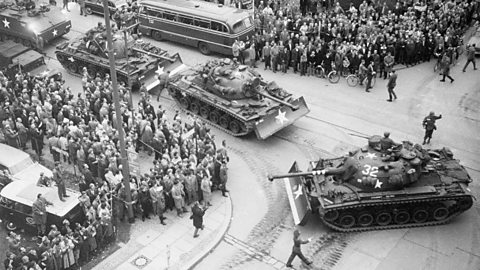
ranchosantafenow.net – The Cold War, a period of geopolitical tension between the Soviet Union and the United States, along with their respective allies, shaped the world from the end of World War II in 1945 until the dissolution of the Soviet Union in 1991. This era, marked by espionage, propaganda, military buildup, and proxy wars, was a defining moment in 20th-century history. It was a conflict that never escalated into full-scale fighting between the two superpowers but had a profound impact on global politics, economics, and culture.

Origins of the Cold War

The roots of the Cold War can be traced back to the end of World War II, when the Allied powers—led by the United States, the Soviet Union, Britain, and France—emerged victorious over the Axis powers. As the war drew to a close, the alliance that had been forged in the fight against Nazi Germany and Imperial Japan began to fray. The Soviet Union, under the leadership of Joseph Stalin, sought to expand its influence and establish communist governments in Eastern Europe. The United States, led by President Harry S. Truman, was determined to contain the spread of communism and promote democracy and free-market capitalism.

The Iron Curtain Descends

The division between East and West became increasingly pronounced with the descent of the “Iron Curtain,” a term coined by Winston Churchill in 1946 to describe the physical and ideological barrier that separated the Soviet-controlled Eastern Europe from the Western democracies. The establishment of communist governments in countries like Poland, Hungary, and East Germany, coupled with the Soviet Union’s refusal to withdraw its troops, deepened the mistrust between the East and the West.

The Arms Race and Nuclear Standoff

One of the most dangerous aspects of the Cold War was the nuclear arms race. Both superpowers sought to outdo each other in nuclear capabilities, leading to a standoff that brought the world to the brink of nuclear war. The Cuban Missile Crisis in 1962, when the Soviet Union attempted to place nuclear missiles in Cuba, is perhaps the closest the Cold War came to escalating into a full-scale nuclear conflict.

Proxy Wars and Global Impact

The Cold War was not confined to Europe. It played out in proxy wars across the globe, as both superpowers sought to influence the outcome of conflicts in Korea, Vietnam, Afghanistan, and elsewhere. These wars were fought not for territorial gain but to spread or contain the spread of communism.

Detente and the Thawing of Tensions

By the 1970s, the costs of the Cold War—both in terms of the economic strain of the arms race and the human toll of proxy wars—led to a period of detente, or easing of tensions, between the United States and the Soviet Union. This period saw the signing of the Strategic Arms Limitation Talks (SALT) treaties and a temporary reduction in the nuclear arms race.

The Fall of the Berlin Wall and the End of the Cold War

The Cold War came to an end with the fall of the Berlin Wall in 1989, a symbol of the division between East and West. This event, along with the subsequent collapse of communist governments across Eastern Europe, led to the dissolution of the Soviet Union in 1991. The end of the Cold War marked a significant shift in global politics, with the United States emerging as the world’s sole superpower.

Legacy of the Cold War

The legacy of the Cold War is complex. While it led to significant advancements in technology and space exploration, it also resulted in widespread human suffering and environmental degradation. The Cold War era also saw the rise of non-state actors and the increasing importance of international organizations, setting the stage for the globalized world of the 21st century.

In conclusion, the Cold War was a period of profound tension and conflict that shaped the world in which we live today. Its legacy continues to influence international relations, reminding us of the dangers of ideological division and the importance of diplomacy and cooperation in resolving global challenges.

History’s Most Dangerous Men: The Scourge of Humanity

ranchosantafenow.net – Throughout history, there have been individuals whose actions have had profound and often devastating impacts on the course of human events. These men, driven by ambition, ideology, or sheer malevolence, have left scars on the fabric of society that are slow to heal, if they ever do. This article delves into the lives and legacies of some of history’s most dangerous men, examining the reasons behind their actions and the lasting effects of their deeds.

Genghis Khan: The Conqueror of the World

Genghis Khan, born Temüjin, rose from a childhood of hardship to become the founder of the Mongol Empire, which, at its height, was the largest contiguous land empire in history. His military campaigns and those of his descendants stretched from Eastern Europe across Central Asia to the Sea of Japan and the Yellow Sea, to the Caucasus and the Black Sea, and to the Persian Gulf and the Mediterranean. While his conquests facilitated trade and cultural exchange along the Silk Road, they also resulted in the deaths of millions and the displacement of countless more.

Adolf Hitler: The Architect of the Holocaust

Adolf Hitler, the Führer of Nazi Germany, is perhaps the most infamous figure in modern history. His aggressive expansionism ignited World War II, and his regime was responsible for the Holocaust, the systematic genocide of six million Jews, along with millions of others deemed undesirable by the Nazi state. Hitler’s legacy is one of unparalleled horror, a stark reminder of the capacity for evil that lies within humanity.

Joseph Stalin: The Man of Steel

Joseph Stalin, the dictator of the Soviet Union from the mid-1920s until his death in 1953, is another name synonymous with mass murder and repression. His policies of collectivization and rapid industrialization led to widespread famine and economic hardship. The purges of the 1930s, in which Stalin eliminated perceived enemies within the Communist Party and the military, resulted in the deaths of millions. His paranoia and ruthlessness left a legacy of fear and mistrust in the Soviet Union.

Pol Pot: The Visionary of Year Zero

Pol Pot, the leader of the Khmer Rouge in Cambodia, sought to transform his country into an agrarian socialist society by abolishing all private property, currency, and religion. His regime, which lasted from 1975 to 1979, is responsible for the deaths of an estimated 1.7 to 2 million people, around a quarter of the Cambodian population. The killing fields and the S-21 prison, now the Tuol Sleng Genocide Museum, are grim reminders of the atrocities committed under Pol Pot’s rule.

Osama bin Laden: The Face of Global Terrorism

Osama bin Laden, the founder of al-Qaeda, orchestrated the September 11 attacks on the United States in 2001, which resulted in the deaths of nearly 3,000 people. His actions led to the War on Terror, including the wars in Afghanistan and Iraq, and fundamentally changed global security policies. Bin Laden’s ideology and the network he created have inspired numerous terrorist attacks around the world, making him one of the most dangerous figures of the 21st century.

Conclusion

The men discussed in this article are among history’s most dangerous not only because of the immediate suffering they caused but also because of the long-term effects of their actions. Their legacies serve as cautionary tales about the dangers of unchecked power, the perils of ideological extremism, and the importance of vigilance in safeguarding against the rise of such figures in the future. It is essential to remember these dark chapters of history not to dwell on them but to learn from them, ensuring that the mistakes of the past are not repeated.